The PhD House Canvas
Architectural Blueprint for a Successful Dissertation
Welcome to your doctoral journey at RISE Group of the Human-IST Institute! The PhD House turns the doctoral process into a clear architectural plan: foundation, pillars, red beam, and roof.

The PhD in pictures
What a PhD actually is
Imagine a circle that contains all of human knowledge.
Images and guide by Matt Might: The Illustrated Guide to a Ph.D., shared under a Creative Commons Attribution-NonCommercial 2.5 License.
Start here
Navigating a PhD can often feel like trying to build a complex structure without a blueprint. To demystify the doctoral process and provide a clear, actionable road map, we have developed The PhD House.
PhD House - Name and share it with Prof. Dr. Edy Portmann. The PhD House Portfolio folder contains shared portfolio material and templates.
- Blank PhD House Canvas Digital blueprint for the Microsoft Whiteboard presentation. Use the PNG version for Microsoft Whiteboard. PDF: reference version. PNG: version for Microsoft Whiteboard. PDF version PNG version
- Finalization Agreement (MS Word)Template for planning the final dissertation phase before building the roof.
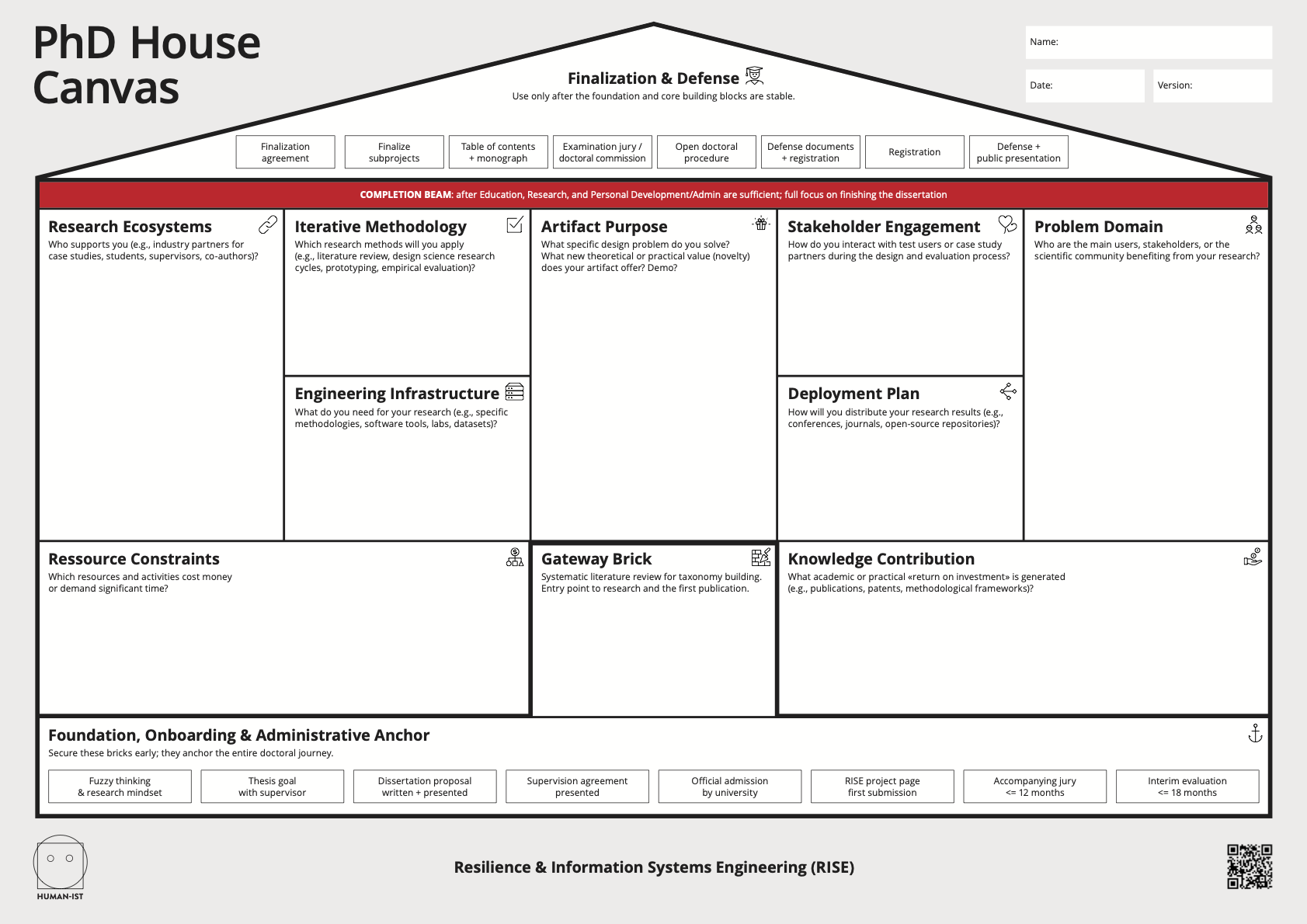
Preview the PhD House Canvas
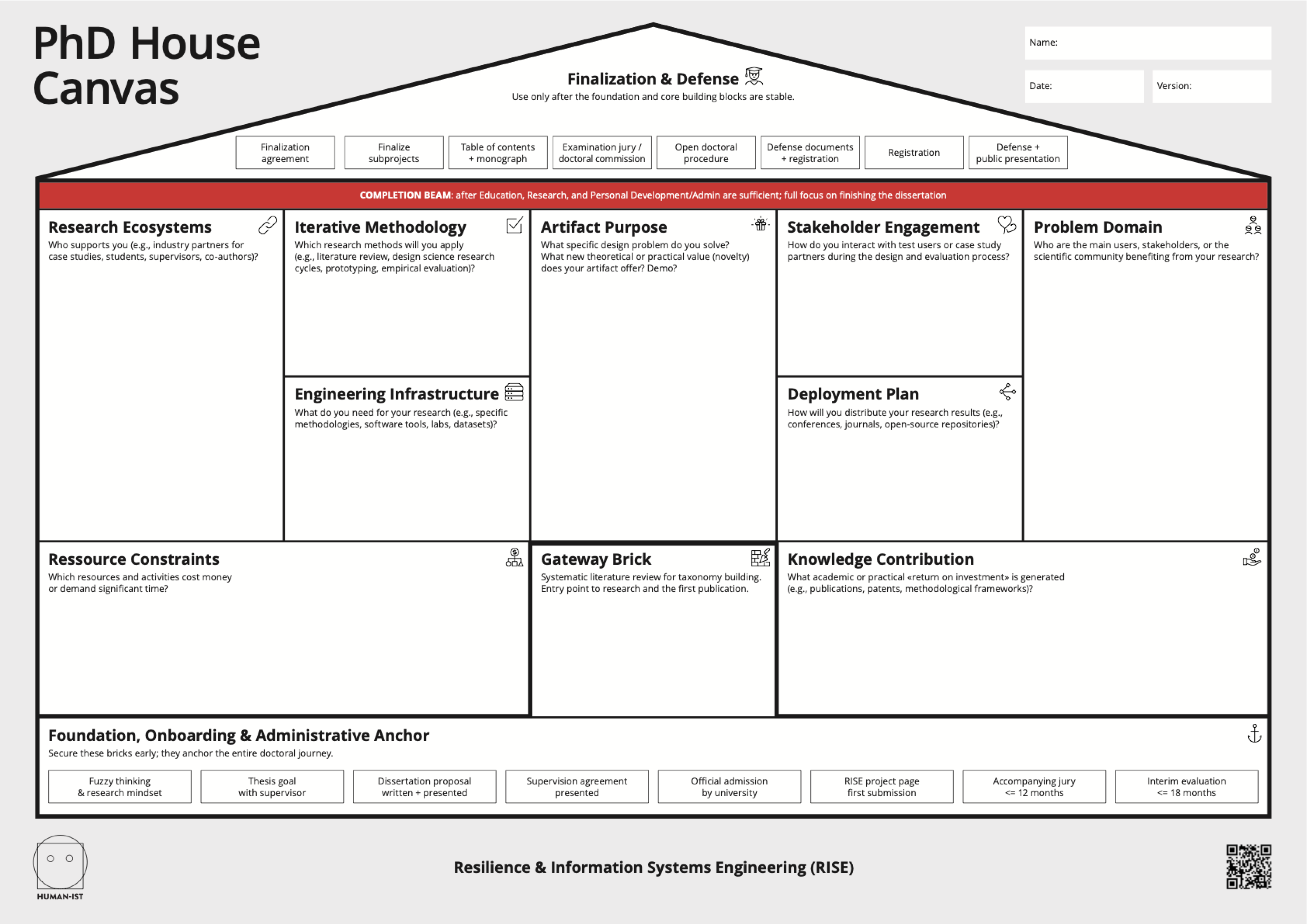 Expand preview
The architectural blueprint
Drawing inspiration from real architectural principles, this visual and structural project management tool is designed to guide you through your 3- to 4-year academic journey. By translating administrative requirements, rigorous research, and personal development into an "architectural plan," you can easily track your progress, identify missing "bricks," and maintain a clear focus on your ultimate goal: a successful dissertation defense.
Phase IV: The Roof
Finalization Phase: Level 4 · Final 6 to 12 months
Pillar 1: Education
Teaching & Mentoring
Pillar 2: Research
Scientific Output
Pillar 3: Personal Development & Administration
Network, methodology, progress, and preparation.
Phase I: The Foundation
Onboarding & Administration
The Blueprint: Building blocks of your PhD
A successful PhD requires more than just writing a final monograph; it demands the construction of a robust, well-rounded academic profile. Like building a real house, you cannot build the roof without laying a solid foundation and erecting load-bearing pillars.
Phase I: The Foundation (Onboarding & Administration)
Every journey begins at the Foundation. This level encompasses the mandatory administrative and conceptual tasks required to officially anchor you as a PhD student at the University of Fribourg. You must secure this base before heavily investing in your pillars:
- Mindset & Philosophy: Read and reflect on the book Fuzzy Thinking by Bart Kosko, which is provided by Prof. Dr. Edy Portmann. This essential, accessible reading will help you grasp the core principles of fuzzy logic.
- Administrative Milestones: Align your overarching thesis goal with your supervisor, write and present your Dissertation Proposal based on faculty guidelines, create your initial PhD House Portfolio, secure your official acceptance by the university, and sign up for all relevant mailing lists.
- Onboarding Responsibility: The doctoral student remains responsible for completing all administrative onboarding tasks, including checking that they are correctly listed on the Human-IST RISE website and relevant mailing lists, and making sure access to the key documents, templates, and SWITCHdrive folders is in place.
- Institutional Visibility: Create and submit your "First Submission Project Page" for the Human-IST RISE website to ensure your research is visible from day one.
- Accompanying Jury: Support jury (consisting of the supervisor, co-supervisor, and 1-2 experts) must be designated ideally at the beginning, and at the latest within the first 12 months.
- Intermediate Evaluation: Must happen at the latest 18 months after admission and involves an oral presentation of your thesis project to the Accompanying Jury.
Phase II: The Three Pillars (Levels 1 to 3)
Once your foundation is firmly in place, you will simultaneously construct the three load-bearing pillars of your PhD.
- Pillar 1: Education (Teaching & Mentoring): To hone your academic profile and deepen your understanding of Design Science Research (DSR), you will actively participate in Prof. Dr. Edy Portmann’s teaching ecosystem.
- Pillar 2: Research (Scientific Output): This is the scientific core of your PhD.
- Pillar 3: Personal Development & Administration: Your PhD is a period of immense personal growth. This pillar ensures you build an active network and strong methodological skills.
More detailed descriptions of the three pillars are available in the Pillar details section later on this page.
Phase III: The Red Beam (Transition & Focus)
At the top of the three pillars lies the Red Beam. Reaching this point signifies the complete release of all three pillars with full focus on completion. Before you can begin building the Roof, you must draft the PhD House Portfolio section on finishing the thesis to plan the exact finalization steps of your dissertation.
Phase IV: The Roof (Finalization Phase: Level 4)
The Roof represents the final 6 to 12 months of your journey. With your undivided attention, you will finalize your major research sub-projects, create your Table of Contents and write the Monograph, define the Examination Jury / Doctoral Commission, submit your Application for the Opening of the Doctoral Procedure, register for Defense with Required Documents, defend your dissertation, complete the Public Presentation, and submit / publish the final thesis.
Pillar details
Pillar 1: Education (Teaching & Mentoring)
- Assisting in Master Lectures: Fuzzy Sets and Systems I & II, Computing with Words.
- Assisting in Master Seminars: Life Engineering, Urban Computing, Social Computing.
- Thesis: Supervising Bachelor and Master theses will further clarify the expectations placed upon you as a researcher.
Pillar 2: Research (Scientific Output)
- The Gateway Brick: To prevent the "blank page syndrome" and provide a structured entry into research, your very first task will be to conduct a Systematic Literature Review for Taxonomy Building*. This highly useful artifact will serve as the gateway to your first publication.
- Scientific Progression: You will conduct major subprojects, aiming for at least three peer reviewed conference or journal papers.
- Continuous Output: You will co-author papers with colleagues, contribute to book chapters, release practical artifacts/prototypes or datasets.
- Regular Project Updates: And continuously update your project page on the Human-IST RISE website.
Pillar 3: Personal Development & Administration
Your PhD is a period of immense personal growth. This pillar ensures you build an active network and strong methodological skills. It tracks your continuous progress reporting, active involvement at the Human-IST Institute, attendance at PhD and Summer Schools (e.g., at the European Society for Fuzzy Logic & Technology), completion of methodology/content courses, and the Thesis Defense Preparation Workshop.
Another key milestone is the Progress Report (Fortschrittsbericht / Rapport d’avancement) in your 3rd year, which is not just an institute interview; it officially involves the Accompanying Jury, and a written protocol must be signed and sent to the Dean's office.
Final roof bricks
- Finalize your major research sub-projects.
- Create your Table of Contents and write the Monograph (integrating your sub-projects).
- Define Examination Jury / Doctoral Commission.
- Submit your Application for the Opening of the Doctoral Procedure.
- Register for Defense with Required Documents: Defense registration has to contain: thesis, CV, declaration of independent work, proof of exam fee.
- The Defense of your Dissertation.
- Public Presentation: After successfully defending the thesis behind closed doors (Art. 31), the candidate must present their results to a wider audience in a public presentation (usually within 1 month after the defense). Note: business informatics PhD candidates do both together.
- Final Submission / Publish Thesis: The doctoral title is not officially granted until the candidate submits the final, corrected thesis and four bound mandatory copies to the Dean's office (within 6 months of the defense). Only then is the diploma issued allowing you to carry the "Dr." title.
Dynamic Assessment: The progression workshop
The PhD House is not a static graphic to be filed away; it is a dynamic, highly tactile tool for semi-annual self-assessment and supervision. To ensure steady progress and foster community exchange, Prof. Dr. Edy Portmann hosts a mandatory Progression Workshop once a semester in Fribourg. Where justified, attendance may be limited to once a year.
Workshop schedule
| Time | Activity |
|---|---|
| 10:50 - 11:00 | Arrival at Human-IST. |
| 11:00 - 12:00 | Short input/kick-off session by Prof. Dr. Edy Portmann. |
| 12:00 - 13:30 | Joint Lunch organised as potluck (Summer Tavolata in the summer semester / Christmas Lunch in the winter semester) to foster team spirit. |
| 13:30 - 17:00 | Individual PhD House Presentations and Assessment Discussions. |
Location and rhythm
When: Every semester, traditionally on the first Monday after the semester.
Where: Human-IST Institute, Fribourg (Room PER21 A440).
How to Prepare and Present: Microsoft Whiteboard
We do not use rigid digital sliders or standard PowerPoint decks for tracking progress. Instead, we use a hands-on, highly visual assessment method that brings your PhD House Canvas to life on the room's large touchscreen in Microsoft Whiteboard.
- Rehearse Your Canvas: Prior to the workshop, carefully update your tabular PhD House Portfolio and use it to walk through how you will fill in your blank PhD House Canvas on your own. Bring your intended filling sequence, or your final filling state, as a small print-out to serve as a memory aid (cheat sheet) during the session.
- Build Your House Live: During the afternoon session, each PhD student has approximately 30 minutes to present directly in Microsoft Whiteboard on the large touchscreen. Working from a blank canvas, you place digital post-its live, representing completed tasks, ongoing projects, and upcoming "bricks", and give a brief explanation of each element as you go. Post-its, reactions, and annotations are added collaboratively in the room.
- Individual Assessment: Following your presentation, Prof. Dr. Edy Portmann will conduct an individual, transparent assessment, discussing the structural integrity of your progress and providing guidance for the next semester.
Refer to the official regulations
Always refer to the official regulations for your individual PhD studies:
Faculty of Science and Medicine
Faculty of Management, Economics and Social Sciences
Ready to start building?
- Study your copy of Fuzzy Thinking by Bart Kosko (provided by Prof. Dr. Edy Portmann) and start laying your foundation.
- Download the blank PhD House Canvas as PDF for reference and as PNG for Microsoft Whiteboard, use the shared PhD House Portfolio folder, and keep the Finalization Agreement ready for the transition to the roof.
- Update your PhD House and get ready for the next Progression Workshop.
We look forward to seeing your architectural masterpiece take shape.
Useful ressources
- The PhD Grind A candid first-person memoir by Philip J. Guo about the everyday reality of doctoral work. It is useful for new PhD students because it makes common struggles, uncertainty, and persistence visible early.
- PhD House Portfolio Drive Contains your personal folder and portfolio material and templates.
- Blank PhD House Canvas Download the PDF version for reference and the PNG version for Microsoft Whiteboard. PDF version PNG version